
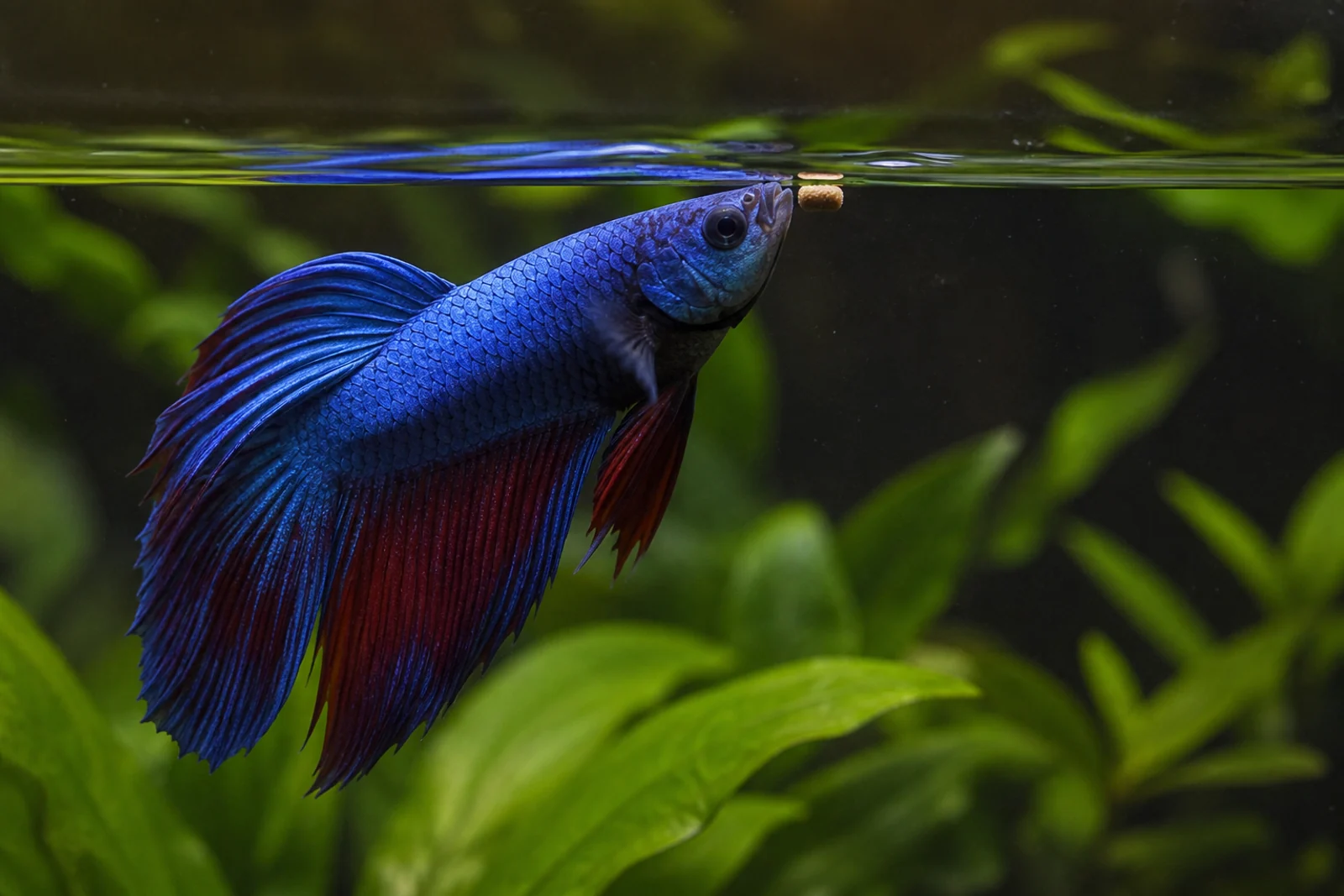
Bettas are carnivores. That single fact settles most feeding questions, and it is the one the packaging tends to obscure.
The other thing worth knowing before anything else: the amount most people feed is several times too much. A betta’s stomach is roughly the size of its eye.
What they eat in the wild
Wild bettas take insects, insect larvae, and small invertebrates from the surface and the water column. Very little plant matter.
That is why a plant-heavy community flake is a poor match, and why the plant-vase kits that claim the roots feed the fish are simply wrong. The fish eats the insects, not the plant.
The staple: pellets
A quality betta pellet, formulated for carnivores, does the everyday work.
What to look for:
- A named protein source high in the ingredient list, such as fish or shrimp meal
- Protein around 40 percent or higher
- Small pellets that fit the mouth of a fish this size
- A floating pellet, since bettas feed at and near the surface
Store them sealed and dry, and replace them once opened for a few months. Vitamins degrade, and a stale tub is worth less than the fish deserves.
How much, and how often
Two to four pellets, once or twice a day. That is the whole answer.
It looks like nothing. It is correct.
| Fish | Per feeding | Frequency |
|---|---|---|
| Adult betta | 2 to 4 pellets | Once or twice daily |
| Small or young | 2 to 3 pellets | Twice daily |
| After a fast day | Normal amount | Do not compensate |
Remove anything uneaten after a few minutes. Every pellet that rots becomes ammonia, and ammonia is what actually harms the fish.
Overfeeding is the real risk
Underfeeding a betta is rare. Overfeeding is close to universal, and it causes harm two ways at once.
The fish gets bloated and constipated, which in turn is associated with swim bladder problems. And the leftovers decay, driving ammonia up in a tank that may not have the biological capacity to absorb it.
A fasting day once a week is a reasonable habit for an adult betta. It gives the gut time to clear and it costs nothing.
Supplements and treats
Variety helps, in small amounts.
Frozen bloodworms, brine shrimp and daphnia are the most useful. Thaw a small portion in tank water and feed a couple of worms rather than a clump.
Live food is excellent if you have a reliable source, and it triggers noticeably more interest than anything dry.
Freeze-dried is convenient but expands in the gut, and heavy feeding of freeze-dried bloodworms is associated with bloating. Soak it first and keep it occasional.
Treat all of these as a few meals a week at most, not as the diet.
What to avoid
- Community flake food as a staple, since it is largely plant-based
- Goldfish food, which is formulated for a completely different diet
- Bread, crackers and human food of any kind
- Anything too large to fit comfortably in the mouth
- Feeding to a schedule that ignores what is left in the tank
When a betta will not eat
A few days of disinterest after a move is normal. Beyond that, work through this in order.
- Test the water first. Ammonia and nitrite are the most common cause of a fish going off food, and no feeding change fixes bad water.
- Check the temperature. A cold betta is a sluggish betta with a slow appetite.
- Try a different food. Soak the pellets, or offer a single thawed bloodworm, which very few bettas refuse.
- Look at the fish. Clamped fins, white patches, bloating or bottom-sitting move this from a feeding question to a health one.
If he is otherwise bright, active and holding his fins open, a short spell of fussiness is usually just that.
Where to go next
Feeding and water quality are the same problem seen from two sides: what goes in uneaten comes back as ammonia. The parameters guide covers what to test and what each reading means.