
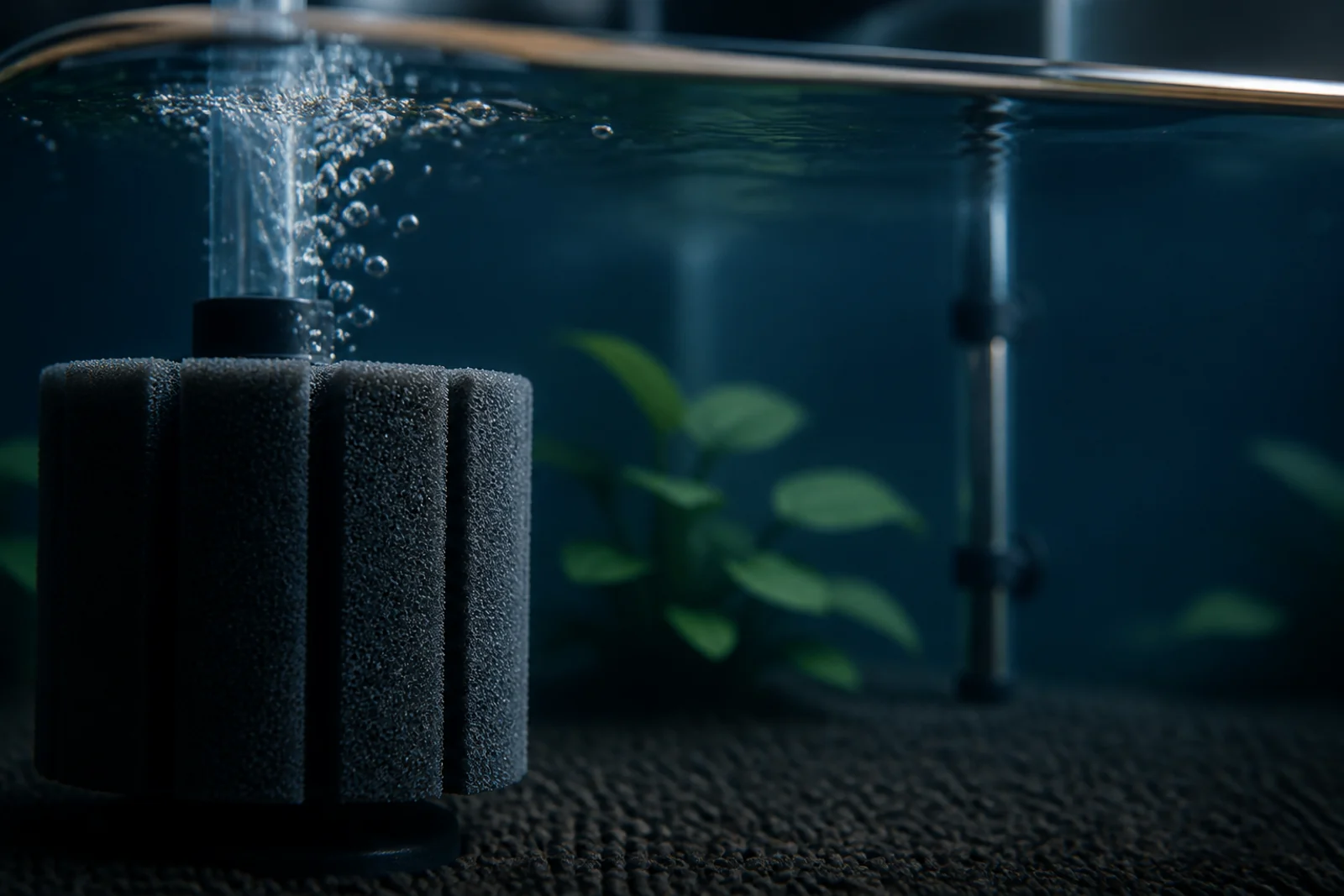
Cycling is the step retail never mentions, and it is the one that decides whether your fish lives out its three to five years or dies in six weeks.
It is also boring. You will spend a month looking at an empty tank and testing water. That is the whole trick.
What cycling actually is
Your fish excretes ammonia continuously. Uneaten food produces more.
Two groups of bacteria handle it. The first converts ammonia to nitrite. The second converts nitrite to nitrate. Both are toxic; nitrate is far less so, and you remove it with water changes.
Cycling means growing those colonies before a fish depends on them. They live mostly in your filter and substrate, not in the water, which is why rinsing filter media under a tap sets you back to the beginning.
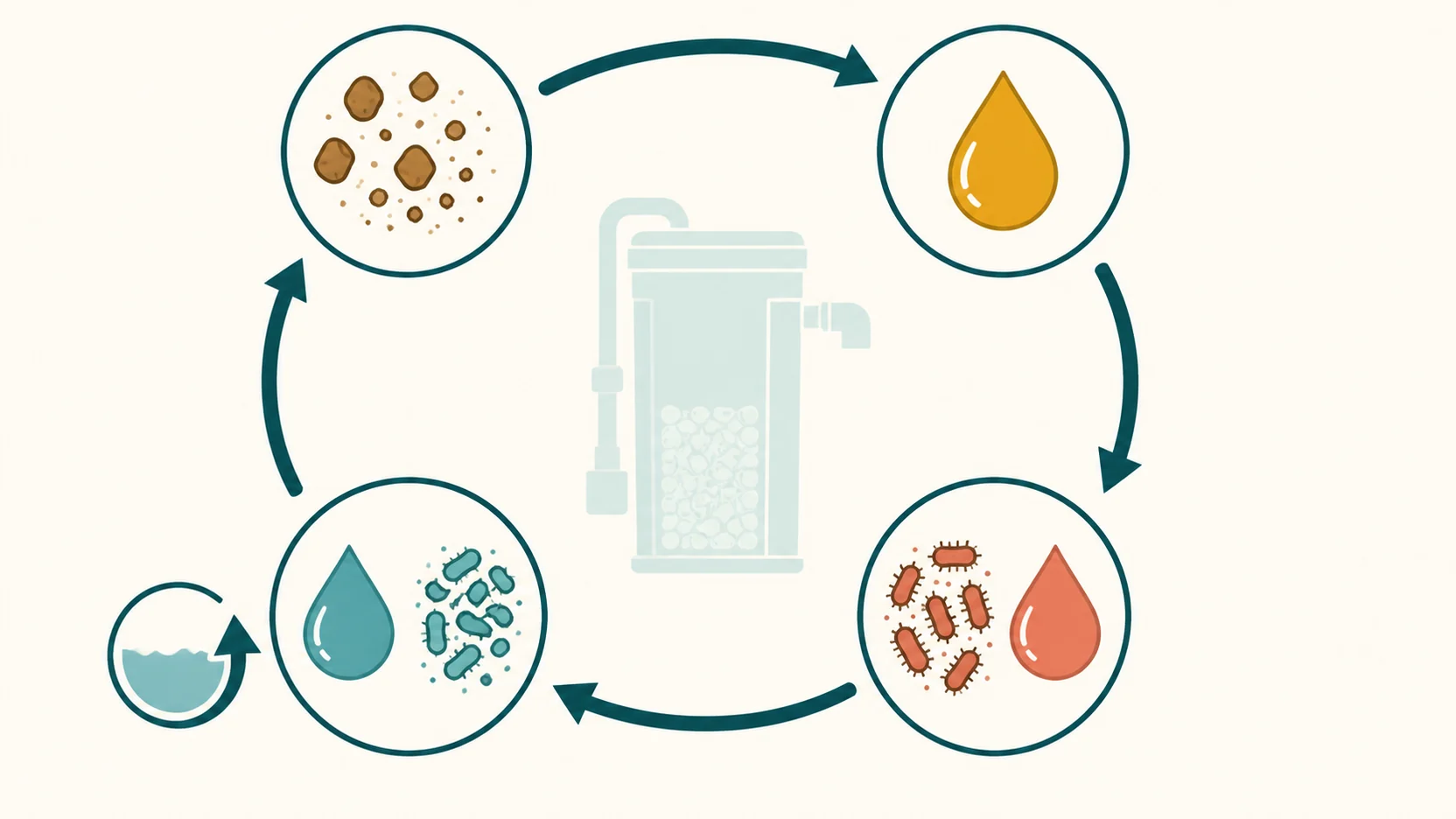
- Ammonia source
- Ammonia
- Nitrite
- Nitrate
What you need
- The tank, set up and running, with heater and filter on
- A liquid test kit that reads ammonia, nitrite and nitrate
- An ammonia source: bottled pure ammonia, or fish food
- Dechlorinator
- Patience, which is the part people skip
Bottled bacteria are optional. Some products shorten the process noticeably and some do almost nothing, so treat any of them as a possible head start rather than a replacement for testing.
The process
1. Get the tank warm and running
Bacteria establish faster in warm water. Set the heater to your normal target of 25 to 28 °C and leave the filter running the whole time.
Never let the filter stop for long during cycling. The colony lives in there and needs flow.
2. Add ammonia
With bottled ammonia, dose to roughly 2 ppm and test to confirm you hit it. Higher is not faster, and very high doses can stall the bacteria.
With fish food, add a small pinch and let it break down. That is slower and harder to control, but it works and costs nothing.
3. Test every day or two, and write it down
You are watching for a sequence, not a single number.
| Stage | Ammonia | Nitrite | Nitrate |
|---|---|---|---|
| Nothing started | high | 0 | 0 |
| First colony working | falling | rising | 0 |
| Second colony working | 0 | falling | rising |
| Cycled | 0 | 0 | present |
A written log is genuinely useful here. Cycles stall, and a log shows you whether you are stuck or simply mid-way.
4. Keep feeding the colony
Each time ammonia hits zero, dose again to about 2 ppm. A colony with nothing to process starts dying back, and you lose progress.
5. Confirm it, twice
The tank is cycled when a fresh dose of ammonia reads zero ammonia and zero nitrite within about 24 hours.
Do that twice before trusting it. One clean result can be luck or a mis-read vial.
6. Water change, then the fish
Nitrate will be high after a month of dosing. Do a large water change to bring it under about 20 ppm, match the temperature, then add your betta.
How long it takes
Three to six weeks is normal without a bacterial supplement. Two weeks happens. So does eight.
Cold water is the most common cause of a slow cycle: below about 21 °C the bacteria barely work. After that it is usually a missing ammonia source, so the colony has nothing to grow on, or chlorinated water added without conditioner, which kills what has grown so far.
Two less obvious ones. Dosing ammonia much above 5 ppm can stall the process rather than speed it up. And cleaning the filter during cycling removes the colony you are trying to establish, so leave it alone until the tank is finished.
The zero-readings trap
A brand new tank reading zero ammonia, zero nitrite and zero nitrate is not clean. It is almost always a tank where nothing has begun.
A cycled tank produces nitrate. If nitrate is absent, the second conversion is not happening, so there is nothing there to protect a fish.
If the fish is already in the tank
Most people arrive here having bought the fish first. It is recoverable.
- Test daily. Ammonia and nitrite are what you are watching.
- Change water whenever either reads above 0.25 ppm, 25 to 50 percent, dechlorinated and temperature matched.
- Feed lightly, because every uneaten pellet becomes more ammonia.
- Leave the filter alone. Whatever colony exists is in there.
- Keep going until both hold at zero between changes.
This takes longer than a fishless cycle because you are removing the very ammonia the bacteria need. That trade is worth it: the fish comes first.
You are not doing anything wrong by being in this position. Almost every keeper starts here, because the fish and the tank are sold together with no mention of what has to happen between them.
Where to go next
Once the tank holds at zero on its own, the weekly routine is what keeps it there, and the numbers are what you check it against.